

Introduction: why a structured SEO audit changes everything
You’ve had a website for years, but organic traffic is flat. You publish content, but your pages do not rank. Or perhaps you simply want to understand where you really stand against competitors. That is where a properly structured SEO audit comes in.
Many entrepreneurs make the mistake of launching SEO campaigns without a prior diagnosis. It is like trying to repair a car without checking the engine: you can put in effort, but without direction.
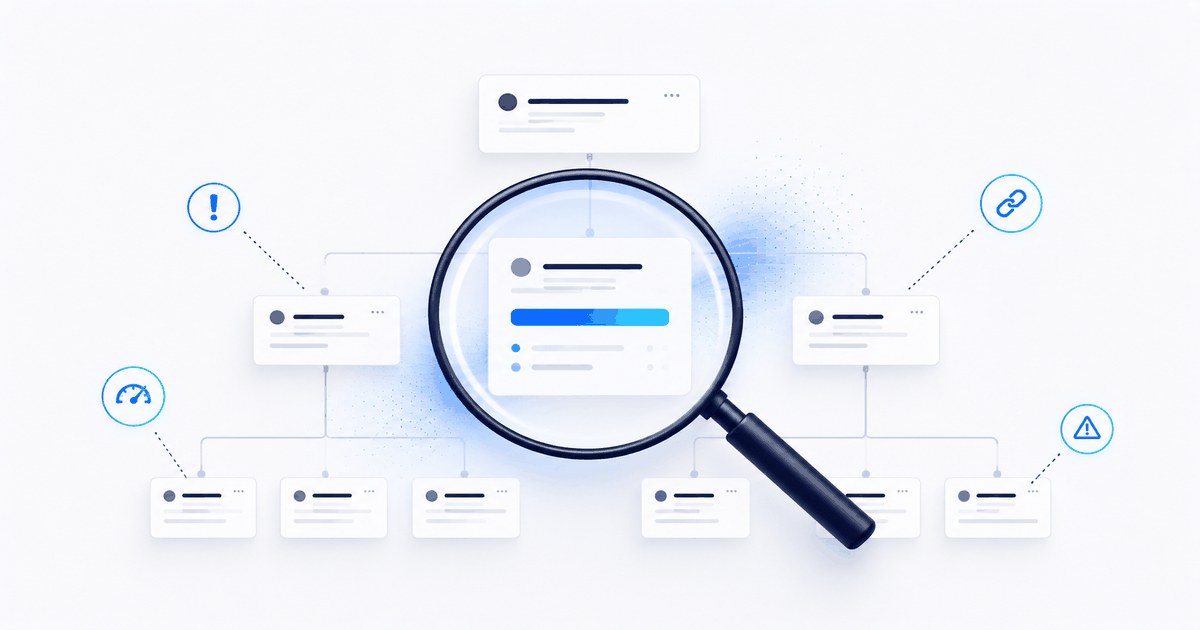
A real SEO audit is not a generic checklist. It is a methodical analysis across four pillars: technical, content, authority and user experience. It shows you exactly where to act first.
An audit establishes the current situation and a roadmap. It guarantees neither doubled visibility, a ranking nor a universal timeframe: results depend on the website, competition and execution.
The 4 pillars of a successful SEO audit
- Technical Access, indexing, structure and errors.
- Content Intent, quality and organisation of answers.
- Authority Links and mentions in context.
- Experience Performance, mobile and user journey.
1. Technical audit: the foundations
The technical side is your starting point. Crawling, indexing or rendering barriers can prevent Google from accessing content correctly, without determining rankings on their own.
You need to audit:
- Indexing: can Google access all your pages? Are any pages blocked by robots.txt or accidentally set to noindex?
- URL structure: is it clear, hierarchical and free of unnecessary parameters?
- Internal linking: how do your pages link to one another? This structure helps Google understand each page’s importance.
- Loading speed: Core Web Vitals are among the signals associated with page experience. Good results do not, however, guarantee a top position. To go further, see our Core Web Vitals guide.
- Crawl errors: 404 pages, broken redirects and 5xx errors. These faults block Google and harm the experience.
- The sitemap and robots.txt: are they configured correctly?
Essential tools for this phase: Google Search Console, Screaming Frog, Ahrefs or Semrush for an overall view.
Prioritise Google Search Console to examine indexing and performance observed by Google. The tool is free, but its data remains aggregated and subject to the limitations documented by Google.
2. Content audit: the substance
A technically sound website is not enough if its content does not usefully answer search intent. A content audit assesses three things:
- Topic coverage: for every targeted search intent, do you have content that truly answers it? Do you cover your clients’ questions?
- Existing content quality: are your articles thorough? Do they offer real value compared with competitors? Are they up to date?
- On-page optimisation: title, description, H1/H2/H3 structure, content clarity and relevant internal links.
Lengthening content solely to reach a word count. Useful length depends on the question: prioritise a clear, complete and original answer.
3. Authority audit: the strength of your brand
Authority is your website’s “prestige” in Google’s eyes. It is reflected in:
- The backlink profile: how many quality websites link to you? Do links come from relevant websites or spam?
- Third-party tool metrics: they can help compare link profiles, but are not ranking metrics supplied by Google.
- Brand mentions: do you appear in relevant contexts (reviews, articles, listings)?
Build authority gradually: create linkable content (guides, studies, data), develop relationships with others in the sector and make sure your brand becomes known.
4. UX audit: the user experience
Google states that its systems consider several signals associated with page experience. Content relevance remains decisive. In particular, examine:
- Core Web Vitals: LCP (loading speed), INP (interactivity), CLS (visual stability).
- Mobile compatibility: Google uses the mobile version of content for indexing and ranking. Rendering must therefore remain complete and usable on a small screen.
- Engagement: do users stay on your page? Is the bounce rate normal for your sector?
Prioritisation: do the essentials first
Once the audit is complete, you will have a potentially long list of problems to fix. Do not try to do everything at once. Use this matrix:
- Impact × Effort: prioritise what has a large impact with little effort (“quick wins”).
- Traffic volume: start with the pages currently generating the most traffic.
- Search intent: think about your ideal clients. Which pages really speak to them?
An indicative prioritisation example, to adapt after measurement:
- Weeks 1 to 2: fix crawl errors and accidentally noindexed pages.
- Weeks 3 to 4: optimise the speed of top-ranking pages.
- Months 2 to 3: review content on high-potential pages (well ranked but not in position 1).
- Month 4 onwards: build backlinks and broaden topic coverage.
Essential tools for a complete SEO audit
You do not need every premium tool on the market. Here is the viable minimum:
- Google Search Console (free): raw data on your performance, indexing and errors.
- Google Analytics 4 (free): understand how users behave once on your website.
- PageSpeed Insights (free): measure Core Web Vitals.
- Screaming Frog (limited free version): crawl your website and detect technical problems.
- Ahrefs or Semrush (paid, but essential): backlink analysis, content gaps and keywords.
Connect your audit to key service pages
With your audit in hand, you can organise improvements to strategic pages. Support from our SEO consultant in Belgium connects these findings to an action plan and results monitoring.
Explore in detail how to optimise your technical and editorial SEO, then go further with a complete audit of your website’s performance and structure. These services guide you towards a clear view and a precise roadmap. If you target clients in Brussels, complement your approach with our local SEO guide for Brussels.
- Validate indexing and technical structure
- Assess the quality and relevance of your content
- Analyse your backlink profile and authority
- Measure user experience (Core Web Vitals, mobile, engagement)
- Prioritise actions by impact and effort
- Implement changes according to a structured plan
- Measure results every month
Conclusion
A well-conducted SEO audit is the smartest investment before starting content or link-building efforts. You save time, avoid unnecessary actions and build on solid foundations.
If you want an in-depth analysis and a precise roadmap for your website, schedule a conversation with Hani. Scope, findings and priorities will be documented before any promise of results.